In the Budget 2018-19, the Minister of Finance Pravind Jugnauth announced that the government will provide funds for the sensitisation and training of households in aquaponics for the production of water adaptive vegetables in freshwater ponds and basins and that the Albion Fisheries Research Centre will provide fish fingerlings freely for the aquaponics projects. Aquaponics is considered as an alternative and sustainable technology for the Mauritian farming industry and an economic alternative for the importation of food crops. Stakeholders share with News on Sunday their views on the feasibility of the measure announced and how to promote Aquaponics in Mauritius.
Sunita Facknath, Professor in Sustainable Agriculture at the University of Mauritius: “The measure must be accompanied by local research to determine the right type of aquaponics”
What are your views about the measure announced in the Budget?
It will help in increasing the share of animal protein in people’s diet, and fish is a good and healthy source of protein and good cholesterol. People will also have fresh and healthy vegetables grown in the aquaponics system.It is also an environmentally friendly way to increase food production while making optimum use of available water, of available space, growing vegetables with little or no fertilisers added, and avoiding the pollution caused by dumping effluent water from aquaculture into the environment.
Do you believe that this measure is sufficient enough to promote aquaponics?
The training and awareness-raising is a start. For it to bear the envisaged fruits, it must be accompanied by local research to determine the right type of aquaponics. There are several ways in which aquaponics can be set up. We need to determine which set-up and type is most suitable for different purposes in the Mauritian context. We need to determine the appropriate conditions, in terms of the water quality, the species and type of vegetables and fish which can be grown in such systems, the number of fish that can be placed in a given size of tank, the safety aspects of the vegetables and fish in the aquaponics system, among others.
What additional measures do you believe should be introduced and why?
In the near future, other measures will have to be considered - establishment of standards and norms for the quality of vegetables and fish emanating from aquaponics, registration of aquaponic businesses for traceability purposes, subsidies on the inputs required, fiscal incentives to those practicing aquaponics as a business, training of extension staff so they can provide right advice and guidance to those practicing aquaponics, and so on.
The Faculty of Agriculture of the University of Mauritius is currently working on a research project on aquaponics, to determine the optimum water quality, species of vegetables and fish to grow together in the aquaponics system, the appropriate density of the fish, the right filter quality, and other similar parameters. This project will provide the necessary data to help us establish a bigger, field level aquaponics unit, and we will be looking for partners in the public and private sectors to partner with us on this bigger project. Source; News On Sunday 23 June 2018


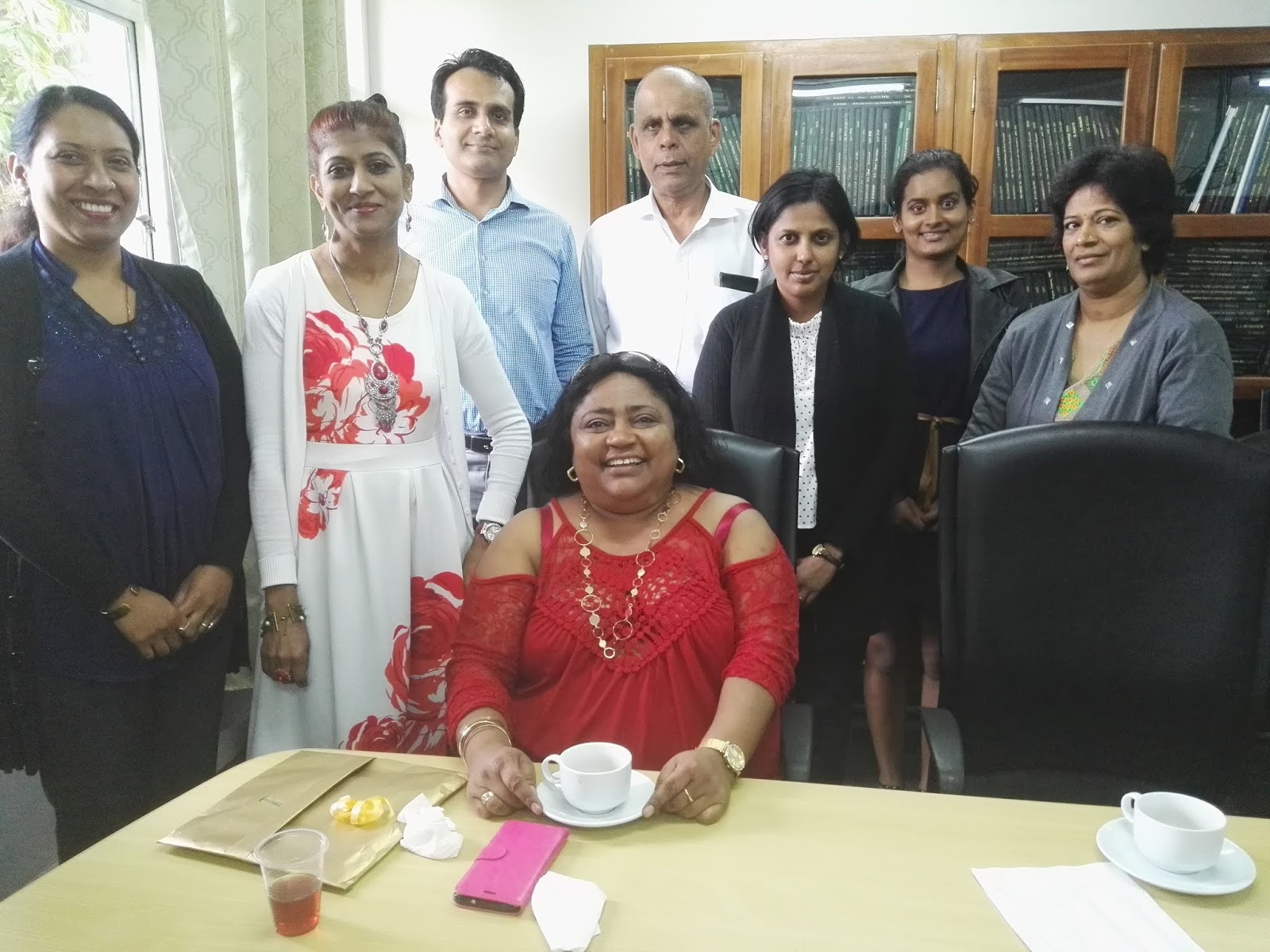
 "Ms Elvina Smith, Lecturer, Central University of Technology (CUT), Bloemfontein, Free State, South Africa, was at the Faculty of Agriculture, from the 18th June 2018 to 25th June 2018, in the context of her PhD study on entrepreneurship education in the field of environmental health, food hygiene and safety. During her visit, Ms Elvina Smith interviewed academics and students of the Faculty of Agriculture. She also had the opportunity to meet the Senior Management of the University of Mauritius, the Dean of the Faculty of Agriculture and key informants from external organisations in the public and private sectors. Ms Elvina Smith delivered a very "enterprising" presentation entitled "Higher Education: South Africa, Sweden and Mauritius, a road towards entrepreneurship", on Monday 25 June 2018 at the Faculty of Agriculture. The aim of her research is to learn from entrepreneurship education in South Africa, Sweden and Mauritius to develop an alternate syllabus in food safety to contribute to improved job skills and innovative ways to address unemployment."